
What Agentic AI Is and Where It Pays Off Fastest
Why this matters
- Tell an agent from a chatbot during a vendor demo, and know what the money buys
- Know which processes are ready for an agent and which need to be written down first
- Calculate payback from operation volume rather than from promises in a slide deck
What agentic AI is, in plain language
A courier can be handed a route sheet: nine addresses, order fixed, one step off it means calling the dispatcher. Or the courier can be handed a goal: deliver nine parcels by six in the evening. The second one decides where to drive first, where to route around traffic, whom to call when the entrance is locked.
Agentic AI is the second option. The model is given a goal and a set of tools: search across a database, access to the system of record, sending email. It picks the order of steps itself and repeats the loop until the task is closed or until it hits a limit.
The difference shows up on a single request. A chatbot replies: "The March invoice is generated by the fifth of the month." An agent opens the billing system, sees that the invoice went to an old address, files a task to update the account details, and sends the document again.
How it works
- A goal is set, not a command. "Read the incoming email and open a deal" instead of "extract the SKU from line 4."
- Tools are provided. Search across a knowledge base, reading from the CRM, writing to the system of record, sending email. Each tool is described in words: what it does, which fields it accepts.
- The model chooses the next step. It looks at the goal and at what has been done so far, calls one tool, reads the result.
- The loop repeats. Typically three to fifteen steps per task. Each step is a separate call to the model, and each one lands on the token bill.
- A boundary triggers. The goal is reached, the step limit is exhausted, or confidence falls below the threshold — and the task goes to a person along with the history of actions.
Point five is what separates a working agent from a demo. The threshold is set by the business: no more than 3% of requests parsed incorrectly means everything below the confidence line goes into an operator's queue.
An example from practice
An illustrative calculation for a service company: 2,400 emails a month, each one a request for an engineer visit. An operator reads the email, pulls out the address and the equipment model, and opens a ticket in the system of record. Three weeks of stopwatch measurement across a sample of 180 emails produced 7 minutes per email.
The agent is given three tools: reading mail, looking up equipment by serial number, creating a ticket. On emails that include a serial number, it closes the loop itself. Where there is no number and the address does not match the customer record, it hands the case to an operator with the fields already filled in.
The benchmark for this profile: 60–70% of emails close without a person, and the rest reach the operator half-completed and take 2–3 minutes instead of seven. There is one way to verify this: a hundred emails are run through the agent in parallel with an operator, and the resulting tickets are compared. The figures above are illustrative benchmarks, not a report from a deployment.
What it gives a business
- The task gets closed, not just answered. Operators stop receiving boilerplate work, and the queue thins out on the part of the flow where the decision is unambiguous.
- New cases do not require a new branch in the script. Where a scripted bot fails on a non-standard email, an agent tries to work it out with the tools it already has.
- Savings can be calculated in advance. Operation volume × operation time × hourly cost is the formula that shows the order of magnitude before anything starts. A rough figure can be produced with the manual process calculator.
- Errors become visible. Every step an agent takes is written to a log, so reviewing a disputed case takes minutes. A manual process leaves no such history at all.
When this can be skipped
A two-step process with rigid rules is cheaper to close with an integration. Moving lines from a form into the CRM does not need a model: it needs a connector, and that costs a fraction as much.
Low volume is the second reason to wait. Two hundred operations a month at three minutes each add up to about ten hours, and mapping the process will eat that saving in the first month alone. Whether a particular process is ready is easy to check with a checklist.
The third case is a process that is written down nowhere. First the rules are pulled out of people's heads and recorded, then the agent is brought in. The reverse order does not work.
What is worth checking
First: at the demo, ask to see the log of steps, not just the final answer. It shows immediately whether the system is choosing the order of actions or walking down a written branch.
Second: ask what happens when an external service fails. An agent with no defined behaviour for an unavailable system of record will halt the entire queue in production.
Third: ask for the cost per task, not the cost of the project. Fifteen steps means fifteen calls to the model, and across thousands of operations the bill is made of exactly those. The budget calculator helps estimate the order of magnitude.
Frequently asked questions
What is agentic AI in plain language?
It is a system built on a language model that is given a goal rather than a command. It picks the order of steps itself, reaches into company databases and services, and stops once the task is closed. An ordinary chatbot answers a question and waits for the next one. An agent reads the request, finds the contract, checks the balance, and drafts the reply — in a single pass.
How does an agent differ from a chatbot and from ordinary automation?
A chatbot produces text; a scripted bot runs a chain written out in advance. An agent picks the chain itself, which makes it useful where the variations are many and writing them all out in advance is expensive. The price of that flexibility is variance: the same input can produce a different decision. Hence the requirement for logs and for a confidence threshold below which the task goes to a person.
At what volume does an agent make sense at all?
The benchmark for the calculation is 500 or more repetitive operations a month, each taking longer than five minutes of manual work. Below that line the hours saved do not cover the cost of mapping the process and supporting it. The math is simple: volume × average operation time × hourly cost of an employee, measured over three weeks of observation rather than from a manager's memory.
What stops an agent from working in a real company?
Usually not the model, but access rights and rules. An agent needs read permissions on the data, an interface to the system of record, and a written procedure — the one that currently lives in the heads of two experienced employees. Until a rule is stated in words, the agent reproduces it by guesswork. Mapping the process usually takes longer than configuring the model itself.
How can it be told that an agent has paid for itself?
Three figures are measured before launch and again two months later: average operation time, the share of tasks closed without a person, and the cost per operation including the model bill. Where the freed-up hours went is recorded separately: without that, the saving stays on paper. The sample should be no smaller than 300 operations, otherwise the variance swamps the effect.
Let’s discuss your project?
Tell us about your process — we’ll suggest where AI pays off fastest.
Related articles
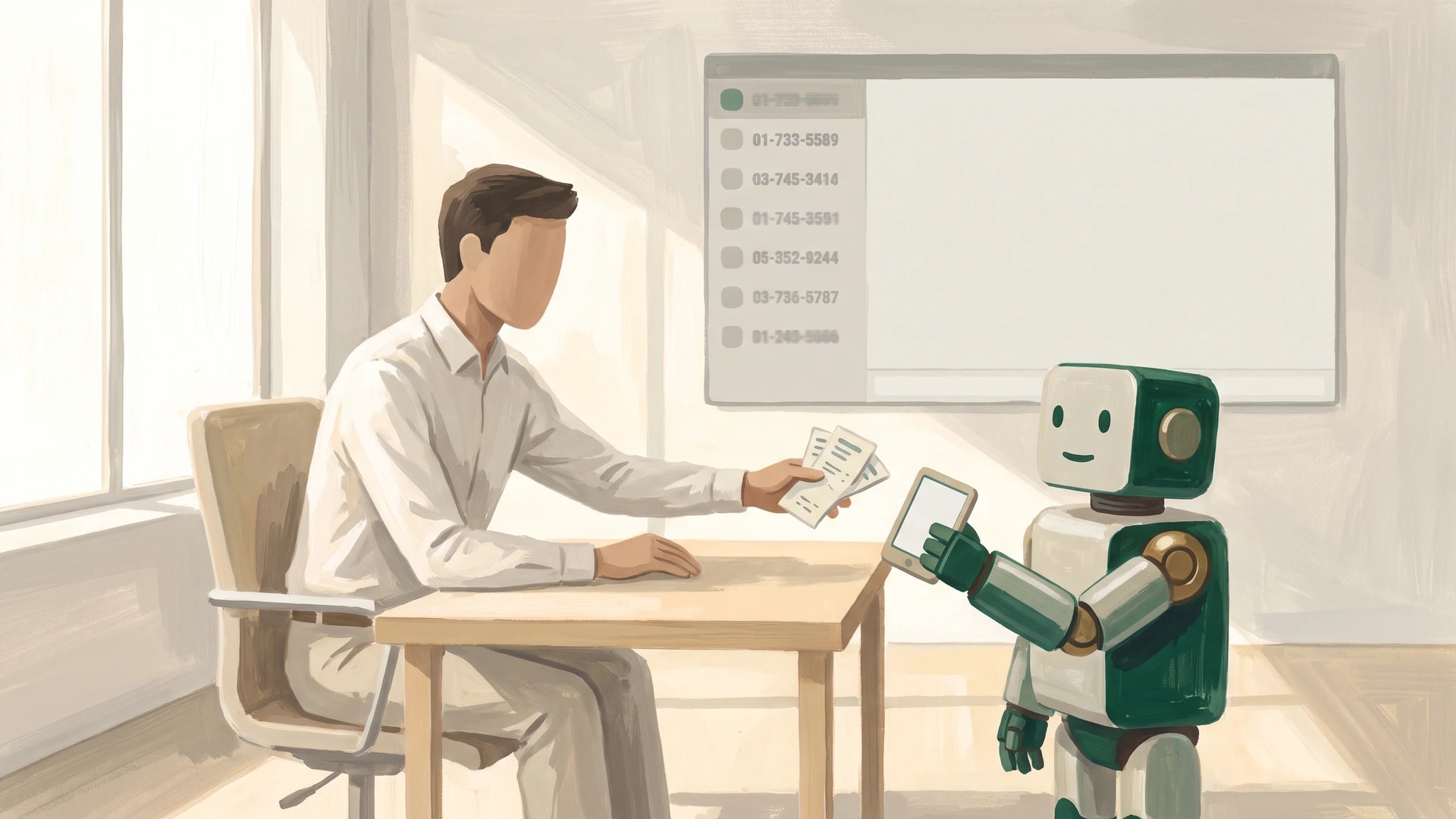
What Is an AI Agent, and How Does It Differ from a Chatbot
An AI agent is a program built on a language model that receives a goal stated in plain words, chooses its own steps, calls the tools it needs, and carries the task through to a result.

AI agent in six weeks: where to start and when it pays off
Breaking a process down step by step delivers a first working version in six weeks. Four conditions for an agent to pay off, and the checks that confirm them in two days.