What Is an AI Agent, and How Does It Differ from a Chatbot
Why this matters
- Understanding what the money buys: an agent costs more to run than a chatbot, and the gap can be calculated in advance
- Telling an agent-shaped task apart from ordinary automation, where a plain script does the job for less
- Knowing which actions must never be handed to an agent, because there is no undoing them
What is an AI agent, in plain words
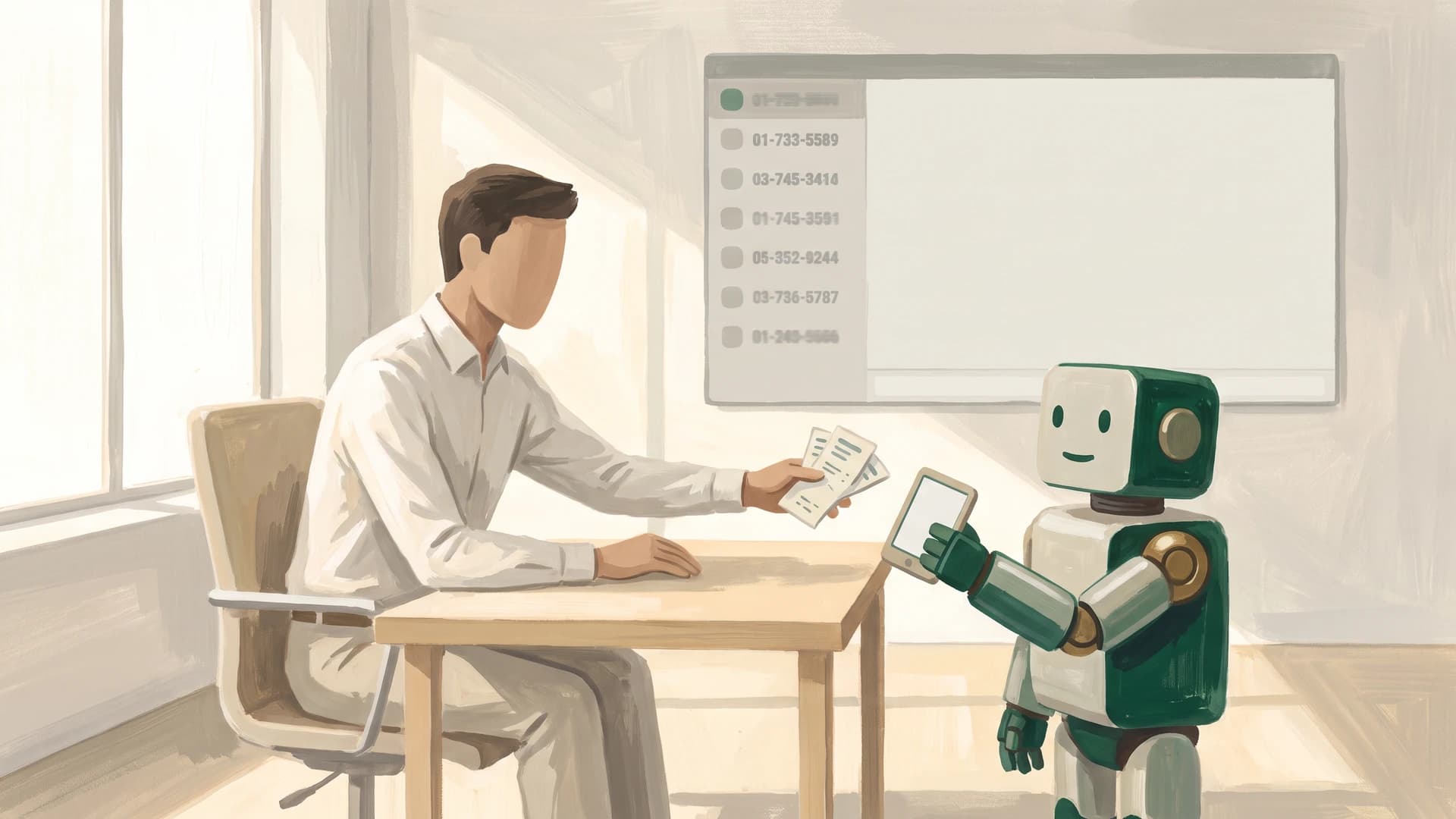
Say the request is lunch for twelve people by one o'clock, budget six thousand roubles. A directory service returns a list of restaurants with phone numbers. An assistant opens the delivery site, compares menus, places the order, pays with the company card, and sends back the order number.
A chatbot works like the directory. An AI agent works like the assistant.
Both rest on the same foundation — a language model. The difference comes down to two things: the agent has been given tools — access to a website, to email, to a company's record-keeping system — and allowed to choose which one to reach for next. There is no step-by-step script, only a goal and a set of boundaries.
Hence the consequence that makes the rest of this worth reading. Once a payment goes through, no single button brings it back. A chatbot's error stays as text on a screen, and a person decides what to do with it. An agent's error is an order, an email to a customer, or a changed row in a database.
How it works
- The goal is stated in words. "Lunch for twelve, delivered by 13:00, under RUB 6,000." The outcome and the limits are set; the order of steps is the agent's to invent.
- The agent takes the first step. It opens the delivery site — that is a tool call. A tool is any function the agent has been permitted to use: web search, reading email, querying a company database, submitting a form.
- It looks at the result and decides what comes next. If a restaurant cannot deliver by one, the agent goes back to the list and takes the next one. The loop of action → result → next action repeats until the task is closed.
- It stops. Either the goal is met, or the allotted step limit runs out, or something is missing — in which case the agent hands the task to a person.
- It reports back: order number, amount, a list of what was done.
A person is needed in two places in this scheme. Before any irreversible action — a payment, an email going outside, a change to data. And at the end, to accept the result. Everything else is decided by configuration: which tools have been issued, how many steps are allowed, what amount counts as the ceiling.
An example from practice
A service company took repair requests by email: roughly 1,200 messages a month. Processing one message took 5–7 minutes — measured across 80 messages over two weeks. A dispatcher read the text, identified the site, filed a ticket in the record-keeping system, and assigned a technician.
The agent was launched in draft mode: it prepared the ticket, and the dispatcher created it with a button press. Over the first two weeks, 27 of 430 drafts came out wrong, most often because the agent confused branches with similar addresses. It was given a branch directory, and the error rate fell to 4 per 500 tickets. After that, ticket creation was handed to the agent entirely, while assigning the technician stayed with the dispatcher.
Checking one ticket takes about a minute instead of six. At a volume of 1,200 messages that comes to roughly 100 hours of dispatcher time a month — calculated from before-and-after measurements.
What this gives a business
- The task gets closed end to end. Ordinary automation copes as long as the steps stay identical. An agent handles the odd cases too: a message from a new supplier, an unfamiliar phrasing, a missing field. Some of those it will still hand back to a person, and that is normal operation.
- The saving can be calculated in advance. The formula is simple: how many minutes the operation takes now, how many minutes will remain for checking, multiplied by monthly volume. If the difference is smaller than the cost of an employee's time over the same period, the project pays for itself — that is the threshold worth measuring against.
- Risk is managed through configuration. Permission for an irreversible action is granted separately and one at a time. While the agent works in draft mode, its mistake costs a minute of someone's time to fix.
- It becomes visible exactly where the process breaks. The step log shows where the agent gets stuck. Those are usually the same places where people stumbled too — nobody was counting before.
When this can be skipped
If there is one step and it never varies — export a file, map the fields, push it into a system — an ordinary integration does the job for less and repeats the result exactly. An agent here adds cost and one more source of errors. A specific case can be checked with the process readiness test: it asks precisely about repeatability, rules, and the price of a mistake.
If the task amounts to answering a question from internal documents, a search over a knowledge base is enough. Independent action is not needed here, and permission to change data even less so.
And where a mistake cannot be rolled back — payments, messages to customers, legally binding documents — the agent stays in draft mode for a long while. The gain in speed there is worth less than the price of a single document sent in error.
What to check
Three things are worth asking a vendor. The full list of tools: what the agent is physically able to do inside a company's systems. The confirmation points: where it is obliged to stop and wait for a person. The action log: whether it is visible after the fact what exactly was done, and whether it can be rolled back.
Separately — limits on steps and on amounts. An agent remains a language model and is capable of being confidently wrong, and without a ceiling on steps a stuck agent walks in circles, with the bill for those calls landing on the client.
And ask for a number: how many real cases the agent was tested on, and how many it got wrong. A demo on three convenient examples says nothing about actual workload. A sound vendor answer sounds like this: a hundred tickets from last month were taken, this many went through without edits, this many had to be redone, and here is the breakdown.
Frequently asked questions
What is an AI agent, in plain words?
It is a program that is given a goal in words and a set of tools: access to email, to a website, to a company's record-keeping system. From there it decides for itself what step to take next, performs it, and looks at the result. It stops when the goal is met, or when it hits a wall and a person is needed.
How does an AI agent differ from a chatbot?
A chatbot answers in text: a question comes in, a reply is written. An agent performs an action: it places an order, files a ticket in a system, sends an email. Both rest on the same foundation — a language model. The difference lies in permissions: the agent has been handed tools and allowed to decide for itself which one to use at the next step, until the task is closed.
What can an AI agent break?
Anything it has been given access to. A paid order, an email already sent to a customer, an altered record in a database — none of these can be taken back. A chatbot's error is wrong text on a screen; a person sees it and does not pass it along. That is why irreversible actions are either left to a human or fenced in with spending limits and confirmation steps.
What does it cost to run an AI agent?
More than a chatbot doing the same job. One exchange with a bot is one call to the model, whereas an agent makes as many calls as the steps required: typically between three and several dozen. What has to be measured is the cost of a single closed task on real examples, before launch, multiplied by monthly volume.
Where should an agent rollout start?
With draft mode: the agent prepares the result, and a person confirms and sends it. Two or three weeks of this produce an honest error rate on real workload and a clear cost per closed task. After that, permissions are widened one action at a time, starting with the reversible ones. Handing an agent payments or customer correspondence on day one is a way of learning the price of a mistake with live money.
Let’s discuss your project?
Tell us about your process — we’ll suggest where AI pays off fastest.
Related articles

What Is a Large Language Model, in Plain Language
A large language model is a program that continues any text with the most likely next word. It learned from books, articles and correspondence, and it answers in human language.

AI hallucinations: why models confabulate and how to catch it
A hallucination is a confident answer that looks plausible but does not match reality: an invented link, a made-up number, or a clause that appears in no regulation.